
Can a Technician Actually Diagnose Your Fridge Over the Phone?
Can a Technician Actually Diagnose Your Fridge Over the Phone?
Quick answer: a technician can often narrow down what’s likely wrong with a refrigerator just from a phone description, sometimes down to one or two probable causes, but a phone call can’t replace an actual hands-on test. What phone diagnosis really does is set honest expectations and let the technician show up with the right parts on the truck, not deliver a guaranteed fix sight unseen. People are often surprised when this actually works. Describing a symptom over the phone and having someone correctly guess it’s likely a loose connection or a specific failing part, before ever seeing the fridge, can feel like a small miracle. It isn’t magic. It’s pattern recognition built from doing the same kind of diagnosis over and over, and there’s a real, honest explanation for what makes it possible and where its limits are.
What Can Actually Be Figured Out Over the Phone
What can a technician actually tell from a phone description of a fridge problem? More than people expect, but less than a full diagnosis. Specific, detailed symptoms narrow things down fast. A fridge that’s completely warm points in a different direction than one where the freezer stays cold but the fresh food side doesn’t. A compressor that hums constantly without ever cycling off suggests something different than one that never starts at all. Unusual noises matter too, a clicking sound every few minutes often points toward a start relay or overload protector, while a constant buzzing points more toward the compressor or a fan motor.
Many newer refrigerators also display error codes on a digital control panel, and those codes are genuinely useful over the phone, since most manufacturers standardize what each code refers to. Reading an error code off the display and reporting it accurately can narrow a diagnosis down considerably before a technician ever walks in the door.
What Absolutely Requires Being There In Person
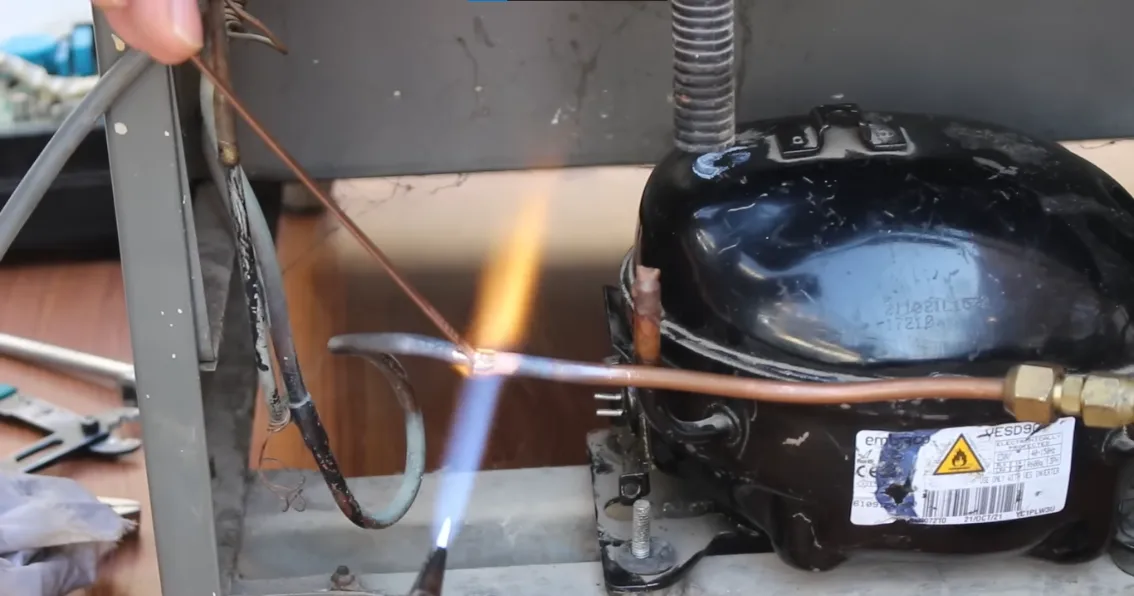
Can refrigerant or electrical problems be diagnosed without an in-person visit? No, and this is the honest limit worth being upfront about. Confirming a compressor’s actual amp draw against its rated specification requires a meter connected directly to the unit. Checking whether the sealed refrigerant system is holding proper pressure requires gauges attached to the system itself. Testing whether a control board’s output matches what it should be requires probing it directly, not guessing from a symptom description. Anyone claiming to diagnose those specific things over the phone with certainty is overselling what’s actually possible.
Why This Still Genuinely Helps, Even Without a Guarantee
If a phone diagnosis isn’t a guaranteed answer, why does it matter? Because it changes what the actual visit looks like. A technician who has a strong idea of the likely cause before arriving can bring the probable part along instead of showing up empty-handed and ordering it after the fact. That alone can turn a two-visit repair into a one-visit repair. It also helps set realistic expectations before any money changes hands, so a homeowner isn’t surprised by either the diagnosis or the price once the technician is standing in the kitchen.
It also matters for something more immediate: deciding whether something is safe to wait on. A fridge that’s merely running warm is a different situation than one making a burning smell or tripping a breaker repeatedly. A phone conversation can help sort out which of those is which, and whether unplugging the unit before help arrives is the safer move.
The Questions Worth Having Ready
A useful phone call works better with specific answers, not vague ones. Before calling, it helps to know:
- Is the whole fridge warm, or just one section while the other stays cold?
- Is there any unusual noise, and does it happen constantly or only occasionally?
- Is there an error code displayed, and what does it say exactly?
- How old is the unit, and is it a standalone or built-in model?
- Has anything recently changed, a move, a power outage, a prior repair?
Answering these clearly turns a vague “it’s not working” into something a technician can actually work with before ever arriving.
Why This Matters More During an Abilene Summer
A refrigerator problem during a West Texas summer isn’t something most people can afford to sit on for a day or two while waiting to see if it resolves itself. Once outdoor temperatures push past 100 degrees, food spoilage risk climbs fast once a fridge stops holding temperature, sometimes within a matter of hours rather than a full day. A useful phone diagnosis in that situation isn’t just about efficiency, it’s about deciding quickly whether food needs to be moved to a cooler right away, and how urgently a technician actually needs to get there that same day versus the next morning.
Where Phone Descriptions Can Actually Mislead
Can describing a symptom the wrong way lead to a wrong guess? Yes, and it’s worth knowing this happens on both ends of the call. A homeowner saying “the fridge stopped working” could mean the compressor never runs at all, or it could mean the compressor runs constantly but never actually cools, two very different problems that call for very different first guesses. The word “leaking” gets used for everything from a cracked water line to simple condensation, which point to entirely different repairs. A technician who asks a few clarifying follow-up questions rather than acting on the first sentence is usually getting to a more accurate starting point, not being difficult.
The Honest Bottom Line
So can a technician really diagnose a fridge over the phone, or is that overselling it? Somewhere in between, and that’s the honest answer. A detailed phone conversation can genuinely narrow down the likely cause, prepare the right parts, and help decide how urgent the situation is. It can’t replace an actual hands-on test of the electrical system, the compressor, or the sealed refrigerant system, and any process that skips that step in favor of a phone-only diagnosis is cutting a corner that matters. The real value of phone diagnosis isn’t certainty. It’s a head start.